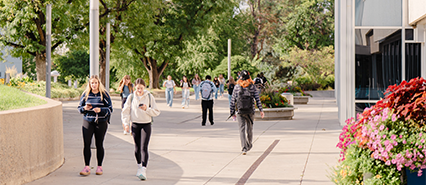
Students Present Original Research at 2026 Spring Symposium
On Friday, April 17, Colorado State University Pueblo held its 2026 Spring Research Symposium, filling hallways and common spaces with poster presentations, student researchers, and a steady stream of visitors stopping to ask questions. For a regional comprehensive university, the afternoon looked a lot like what research is supposed to be. Students were not displaying class projects. They were presenting original work with real implications for science happening at the national level.
One of the afternoon's most talked-about moments had actually happened days earlier, across state in Fort Collins. Sandra Bandimere, laboratory coordinator at CSU Pueblo who is also pursuing her master's degree, won the CSU Pueblo Award at STRATA's Demo Day on April 14. The award came with a $1,000 prize and recognition from a system-wide competition that included student innovators from across the Colorado State University system.
Bandimere's research centers on cachexia, a body-wasting syndrome associated with vascular cancer. Her preclinical mouse model study examines whether specific dietary interventions affect tumor size and quantity. At the symposium Friday, she stood beside her poster—charts and pie graphs mapping tumor area across intestinal regions—and walked visitors through what the data did and did not show.
“In this portion of the study, I have not found significance. The diet did not have an effect on tumor size or quantity. If it did, you could take this study and apply it to humans.”
Sandra Bandimere, Laboratory Coordinator, CSU Pueblo
She was clear that a negative finding is not a failed study. Without ruling out one variable, researchers cannot move responsibly to the next layer: adding exercise, adjusting concentration, introducing additional interventions. Grip strength, body weight, blood work, and skin data all remain to be analyzed. The work continues.
Aly Hoeher, Licensing Manager for STRATA, attended the symposium to support exactly that kind of research. STRATA is a separate 501(c) organization that serves the entire CSU system through its Technology Transfer Branch. The office manages patents, copyrights, and trademarks for ideas emerging from CSU institutions, then works to connect those innovations with companies that want to license and commercialize them.
Revenue generated through licensing returns to the universities, departments, and individual researchers who produced the original work.
Hoeher attends both the spring symposium and the fall STEM Research Symposium in Pueblo each year. She described Bandimere's Demo Day win with obvious enthusiasm, noting that judges from across the CSU system reviewed the presentations and selected Bandimere's from a competitive pool representing multiple campuses.
“We love seeing the ideas and innovations that students are coming up with. There's great research happening down here.”
Aly Hoeher, Licensing Manager, STRATA — Colorado State University System
Elsewhere in the room, undergraduate students from the biology department presented research on the mutagenic effects of Saccharomyces cerevisiae, a model yeast organism, when exposed to leachates from the Pueblo Colorado Superfund Site. The research team included Kristina Kizewski, James Carsella, Amaya Garcia, Moussa Diawara, and Claire Varian-Ramos.
Their methods included toxicity assays, CNV detection, and statistical analysis in R Studio to examine how environmental contamination affects genetic mutation rates. The Superfund site, a legacy of industrial contamination in the Pueblo region, gave the project direct local relevance.
CSU Pueblo holds Carnegie Classification recognition as a research institution, a designation that reflects the university's investment in sponsored research and faculty-student scholarship. The Spring Research Symposium stands as one of the most visible expressions of that work, a public accounting of what students are building, measuring, and discovering in labs that may not make national headlines but produce research that matters beyond the campus.
About the Research
Cancer & Cachexia Study
Sandra Bandimere's preclinical research uses a mouse model to examine whether dietary interventions affect tumor size in cases of cachexia, a body-wasting syndrome associated with vascular cancer.
Superfund Site Mutagenesis
Biology students examined how leachates from Pueblo's Colorado Superfund Site affect genetic mutation rates in Saccharomyces cerevisiae yeast using toxicity assays and CNV detection methods.
About STRATA
STRATA is a separate 501(c) nonprofit serving the Colorado State University system through its Technology Transfer Branch.
The office manages patents, copyrights, and trademarks for university-generated research, connects innovations with commercial partners, and distributes licensing revenue back to researchers and institutions.
STRATA attends both the Spring Research Symposium and the Fall STEM Research Symposium at CSU Pueblo annually.